With our recent focus on beauty standards in the classroom, I have taken some interest in finding how the standards we are used to here in America compare to those around the world. Unsurprisingly, there was a plethora of studies and even videos doing just that, some of which had some data that seemed to go completely against the typical western standard of beauty. One video done in 2014 (linked at the end of post) showed a woman who sent a picture of herself to photoshop editor around the world and asked them to simply "Make me beautiful." The different transformations sent back were incredible, but one thing that really stuck out to me was towards the end of the video when they showed how the US editor portrayed the woman. The editor had basically reshaped her entire head so that it was about 1/3 the size it used to be and shrinking her hairstyle, aligning with our recent readings that emphasized the how women were expected to "take up less space". Interestingly enough, editors from countries such as the Philippines exaggerated her facial features by adding makeup and volumizing her hair by straightening it and it having it drop past her shoulders. However, this type of hairstyle is very uncommon as a large portion of Philippine woman have curled hair, which seems to suggest that countries find beauty in what is in contrast to their natural beauty.
When it came to makeup, a UK study found that women spend 474 days of their life applying it to themselves, and another survey done in the US found that 91% of women would rather cancel a first date than attend it without makeup on. This just goes to show how much pressure it put onto women to hide their true face, whereas men do not typically have to worry about the same kind of judgment. At least, that's what's typical. It seems that in East Asian countries, especially South Korea, even men are expected to be above a certain standard of beauty. In S. Korea, a headshot and even your weight is expected on formal applications such as resumes, which comes to no surprise coming from a country that has the highest per capita rate for plastic surgery. There exist what is known as the "flower boy" concept in which is similar to the "pretty boy" look we see in the US. And yet the western influence does not stop there, for the most highly sought for plastic surgery treatment for men in S.Korea is nose surgery. They are given higher nose bones so that they look more like westerners, and similarly women often attempt to switch their monolids to that of the typical western double eyelid.
Despite the heavy focus on physical beauty, surveys done in multiple countries seem to suggest at that at least 60% of people look for an inner beauty when looking for a partner. This goes to show that looks aren't everything, and everyone can come off as more attractive simply be being a kind and humble human being.
https://www.youtube.com/watch?v=RT9FmDBrewA <-----link to beauty standards video
This class has opened my eyes to many things I may not have noticed otherwise. While I had some awareness of how women were objectified or held to standards to which they couldn't adhere, I wasn't aware of just how much toy commercials impacted the intended audience. I decided to do some digging.
These are some of the Barbie commercials from that beautiful time period that was the 1990s. It is a bit lengthy, but I recommend watching at least the first few commercials. They go by fast. My personal favorite, simply because I find it funny, is "Teacher Barbie" at 5:47.
There you have it. Had your laugh? Good. Me too.
In those commercials, it's easy to get caught up in what Barbie can do, what you can make Barbie do, her constant romance with Ken, the fashion and the style, everything about the appearance of how glamorous Barbie can be in her different roles. You can tell that these are the kinds of things that girls will look for in themselves. "Barbie is glamorous with glitter in her hair, so I must have glitter in mine as well!"
Piercy's "Barbie Doll" was published in 1971, twenty years before these commercials came out, and not much had changed. These commercials do almost nothing to promote the self-esteem of young girls in what they can do as individuals, only as what Barbie can do. They need the newest Barbie to fit in with society or do the things that Barbie can do. One commercial I recall was from the 1960s and it spoke of Barbie's new arms and legs that could actually move, just like a real person! Personally, that made it seem easier to play with the doll, but again, did nothing to promote girls' self-esteem.
Now granted, I grew up with Barbies, so I was in awe of some of the products that existed before I knew they did. I never remember wishing I was more like the dolls I played with, that my hair was as sleek as theirs, or my arms as toned. On one hand, I don't believe children actively think that they should look like their dolls. That may just happen subconsciously. On the other hand, I don't think there should be a reason for girls to feel less than acceptable in society. They need to know that from a young age, they belong, that they have a place.
That's why it heartened me to hear of the new Barbies Mattel made. Barbies now come in tall, petite, and curvy, including all body types. Now, Barbie has realistic legs, arms, and a more realistic shoulder to waist ratio. While it may be harder to shop for clothes for the newly shaped Barbies, it appeases those children who do feel less than acceptable because of their toys. It shows them that people, like their new dolls, come in all shapes, sizes, and colors.
In recent years, Barbie has been making some pretty progressive changes. For one, the commercials have changed. Ruth Handler, the creator, said "...through the doll, the little girl could be anything she wanted to be. Barbie always represented the fact that a woman had choices." This quote alone shows that the correct mindset was always present, that just the bodily proportions were a tad off.
The other night I was watching a movie on television and the following commercial came on. It came out in 2015, but I had forgotten about it and it made me aware of the awareness I have now of the messages being sent to little girls. Watching the other older commercials had almost an "in-your-face" tone, what with the upbeat and bouncy music, bright colors, and typical 90s vibe. The new commercial has an uplifting attitude, shows that girls can do whatever they want to do and succeed, and promotes a positive self-image. Take a look for yourself, even if you've already seen it.
This commercial brought me back to the days when I played with Barbies, when I acted out miniature kid-friendly soap operas, or got the kids ready for school, or even "homeschooled" the kids (because I had so much knowledge about that topic---Haha. NOT).
It is a positive influence for younger girls. These girls are taking on the roles of college professor, men's soccer coach, paleontologist, veterinarian, and who knows what else. As of this year, Barbie even has a president and vice president doll, among many others. It is heartening to know that standards for little girls are changing, that they are now being pressured to stand up against the pressure against them. I mean, as soon as they become "women," society will place new standards on them. At least for now, maybe, just maybe, they'll escape the cynics and critics of the world and escape to their imaginations instead. With the bodily changes and the public appearance Barbie has changed, maybe, just maybe, these young girls will have enough positive influence in their lives, either from their toys or the changing world around them, to make positive changes for the generations to come.
From
a young age women are often told what society expects us to look like. They
want us to be small among other things. On the other hand, men are ridiculed if
they aren’t large enough.
This
has been happening for centuries. It varies by culture, but many Western
cultures view it the same way. For example, in the Victorian era many women
wore corsets in order to appear small in stature. (It also restricted their
movement.) Many women had bruised or broken ribs because they would tie it so
tight. This obviously wasn’t something healthy, and it’s sad that women had to
go to great lengths to feel “beautiful” according to society’s standards. That’s
why eating disorders are very common in women and why Kyle Lukoff struggled in Taking Up Space. (He's an FTM who struggles with an eating disorder.)
As
I mentioned earlier, the corset also restricted a woman’s movement. Today women
will often wear pencil skirts and heels or tightly cinched dresses, making it
much harder to move around. I think the reason why clothes tend to restrict a
woman’s movement is because if she can’t move around as much she won’t be
taking up so much space.
Think about it. If you’re at a gathering and
someone moves around the house a lot, you’re going to think that person is
taking up a lot of space. You saw them over here earlier and now they’re over
there. Even if that person only circulated a few spots, if they’re constantly
moving it’s going to feel as if they’re taking up all of those spots. It’s
similar to – if someone wants to look busy but doesn’t want to do actual work
he/she can move around a lot and people will think that person has done a lot
because they saw him/her in many places i.e. he/she took up a lot of space.
This
goes a step forward when it is applied to height. Women can’t be too tall and
men can’t be too short. Very tall men are often praised for their height
because that somehow makes them more “manly.” The view of weight/size is to be
expected but height throws me a little over the edge. People can’t control
their height; it’s genetics. Even though women aren’t supposed to be tall, they
can’t be too short either. True, this may be because men are on average taller than women. However, it doesn't make much sense to ridicule people because of their genes.
The woman is society sternly seeing if the girl is an appropriate height.
Society’s
pressures are even worse on transgender people. How Lukoff acts – if he takes
up more space or tries to be smaller – determines whether others perceive him
as masculine or feminine. I can only imagine this being harder for someone
transgender, which is enough of a struggle without the addition of an eating
disorder.
Of course, I wish society wasn’t this way. However, I don’t
see a change happening anytime soon. Too many people are sucked into the
pressures and can’t escape. People will always want a standard of beauty or
masculinity – not all people, but a good portion of people. Despite this
negativity we should fight these standards with the hope of a better future.
I mean, at least women don't have to wear corsets anymore.
Being a female and trying to aim for the impossible beauty standard can be daunting, especially when that beauty standard is a different race. Kenji's story in Gender Outlaws resonated with me, as I understood Kenji's frustration with non-Caucasian individuals taking up Caucasian names to appear more attractive.
Many Asian brands hire Caucasian instead of Asian models.
When I recall the portion of my childhood spent in China, I remember seeing beautiful female models promoting a variety of beauty products in TV commercials, magazine covers, and poster advertisements. Most of these female models were Caucasian. They were hired by Asian brands for these advertisements, even though only a tiny proportion of the population in China is Caucasian. If models are supposed to be beautiful, and these Asian brands had gone to such lengths to hire Caucasians over Asians for modeling, then it must have been because Caucasians are more beautiful than Asians. This is what my eight-year-old mind concluded and continued to believe for many years afterwards.
Gluing eyelid to create double lids.
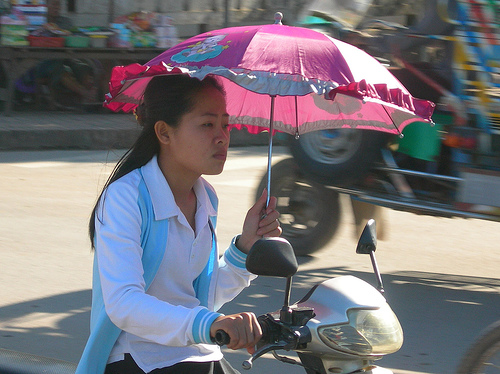
While growing up in China, I learned that females with white skin, double eyelids, blonde/brown hair, and wavy/curly hair were considered attractive, while females with dark skin, mono-eyelids, and straight black hair were considered ugly or plain. Women and young girls in China undergo obsessive lengths to achieve these stereotypical Caucasian features, even though only a minority of Chinese women are born with double eyelids and a very rare minority with brown hair or wavy/curly hair. Females in China use umbrellas to prevent their skin from darkening under sunlight, apply skin-whitening lotion onto their skin multiple times per day, and undergo plastic surgery to obtain double eyelids. Whenever I visited my countless relatives in China, they would either compliment my double eyelids or fuss over the relatively dark color of my skin and offer tips on how to make my skin whiter. Almost all of mainland China’s top celebrities have fair skin, double eyelids, and dyed/curled hair.
One of many Chinese advertisements promoting white skin.
Holding a "sun-brella" while driving.
While spending the other half of my childhood in the USA, I continued to believe that Caucasians were the beauty standard. My fair blonde-haired, blue-eyed, and fair-skinned Caucasian Barbie Dolls and Polly Pockets reinforced this idea. Even in anime imported to the USA from Japan, I noticed that the blonde-haired, blue-eyed, and fair-skinned female characters were portrayed as the pretty characters. Similarly, the majority of Hollywood actresses are Caucasian or have conventionally Caucasian physical features. In the movies themselves, the romantic leads, princesses, cheerleaders, popular girls, CEOs, and lawyers would be Caucasian. During the rare times I saw Asian characters on screen, they would be portrayed grotesquely, such as in “Breakfast at Tiffany’s.” Other movies, such as “Memoirs of a Geisha”, suggested to me that Asian females could become beautiful if they wore blue contacts to look more Caucasian.
Ugly portrayal of Asians by Caucasian actor in movie.
According to another movie, blue eyes are prettier.
Although I have heard arguments that China’s beauty standard has nothing to do with wanting to look Caucasian, my interactions with other people have led me to believe otherwise. A friend in China once told me that my friends in the USA must be very pretty because they are Caucasian. She did not believe me when I explained that beauty was subjective (and that only a portion of my friends in the USA were Caucasian). In a separate conversation, a neighbor once told me it was a universal truth that Caucasians are the most beautiful race. In another scenario, a cashier once mistook my grandma for a Caucasian-Asian mix after my grandma revealed she had spent several years living in the USA. The cashier told my grandma that it made sense because my grandma was better-looking than “pure” Asians. Although these stories are only anecdotes, they have shown me that at least some females, if not a frighteningly large number of females, view Caucasians as the beauty standard.